
Two rough edges remain in the finished game. Every plan edit blanks the whole screen and builds it again, so the screen flashes each time you press Enter. And Q stops the program wherever it happens to be, leaving a bare 9 STOP statement report under whatever was on the screen. This lesson fixes both. The accounts, traveller offers and decade reviews stay exactly as they were.
Replace lines 120, 270, 310, 330, 335, 340, 350, 510, 2138, 2140, 2150, 2160, 2162, 2164, 2166, 2170, 2190, 2200, 2210, 2220, 5150, 7180.
Add lines 280, 1900, 1910, 1920, 1930, 1940, 1950, 1960, 1970, 1980, 2168, 2225, 2245, 9000, 9010, 9020.
Delete lines 2090, 2100, 2110, 2120, 2130, 2180.
To delete a BASIC line, enter its number on its own. Line 1900’s string is 31 spaces; count them, because the padding below depends on that length.
 120 IF k$="q" OR k$="Q" THEN GO TO 9000
 270 GO SUB 1900
 280 GO SUB 2000
 310 IF k$="q" OR k$="Q" THEN GO TO 9000
 330 IF k$="b" OR k$="B" THEN LET edit=1: GO SUB 6000: GO TO 280
 335 IF k$="s" OR k$="S" THEN LET edit=4: GO SUB 6000: GO TO 280
 340 IF k$="f" OR k$="F" THEN LET edit=2: GO SUB 6000: GO TO 280
 350 IF k$="p" OR k$="P" THEN LET edit=3: GO SUB 6000: GO TO 280
 510 IF k$="q" OR k$="Q" THEN GO TO 9000
1900 CLS : LET b$="                               "
1910 PRINT AT 0,1; INK 6; BRIGHT 1;"YEARFALL";AT 0,20;"YEAR ";yr
1920 PRINT AT 2,1; INK 5;"PEOPLE ";pop;AT 2,17;"LAND ";land
1930 PRINT AT 3,1; INK 5;"GRAIN  ";grain;AT 3,17;"PRICE ";price
1940 PRINT AT 5,1; INK 4;"PLAN";AT 5,17;"AMOUNT";AT 5,25;"COST"
1950 PRINT AT 6,1;"B  Buy land";AT 7,1;"S  Sell land"
1960 PRINT AT 8,1;"F  Feed grain";AT 9,1;"P  Plant acres"
1970 PRINT AT 12,1;"Food needed: ";3*pop
1980 RETURN
2138 PRINT AT 6,17;buy;"    "
2140 PRINT AT 7,17;sell;"    "
2150 PRINT AT 8,17;feed;"    ";AT 8,25;feed;"    "
2160 PRINT AT 9,17;plant;"    ";AT 9,25;plant;"    "
2162 LET t$="No land bought or sold."
2164 IF trade>0 THEN LET t$="Spend "+STR$ cost+" grain on land."
2166 IF trade<0 THEN LET t$="Receive "+STR$ (-cost)+" grain for land."
2168 PRINT AT 10,1; INK 6;t$;b$( TO 31-LEN t$)
2170 PRINT AT 11,1; INK 6;"Grain left: ";left;"    "
2190 PRINT AT 13,1;"Land after trade: ";acres;"    "
2200 PRINT AT 14,1;"Fed workers can plant: ";2*fed;"    "
2210 PRINT AT 16,1; INK 6;m$;b$( TO 31-LEN m$)
2220 LET t$="": IF ok=1 THEN LET t$="After harvest: "+STR$ (left+2*plant)+" to "+STR$ (left+5*plant)
2225 PRINT AT 17,1;t$;b$( TO 31-LEN t$)
2245 PRINT AT 21,1;b$
5150 IF k$="q" OR k$="Q" THEN GO TO 9000
7180 IF k$="q" OR k$="Q" THEN GO TO 9000
9000 CLS : PRINT AT 9,12; INK 6; BRIGHT 1;"YEARFALL"
9010 PRINT AT 11,6;"Thanks for playing.";AT 13,8;"RUN plays again."
9020 STOP
Complete source at this checkpoint
  10 BORDER 0: PAPER 0: INK 7: CLS
  20 PRINT AT 3,10; INK 6; BRIGHT 1;"YEARFALL"
  30 PRINT AT 6,1;"One settlement. Keep it alive."
  35 PRINT AT 7,2;"Review every ten years."
  40 PRINT AT 8,2;"Feed people. Plant a harvest."
  50 PRINT AT 9,2;"Keep grain for a poor year."
  60 PRINT AT 11,2;"Each person needs 3 grain."
  70 PRINT AT 12,2;"Each worker farms 2 acres."
  80 PRINT AT 13,2;"Each acre costs 1 seed grain."
  90 PRINT AT 15,2;"Harvest: 2 to 5 per acre."
  95 PRINT AT 16,2;"Full food: 5% newcomers."
 100 PRINT AT 18,2;"S starts. Q quits."
 110 GO SUB 8000
 120 IF k$="q" OR k$="Q" THEN GO TO 9000
 130 IF k$<>"s" AND k$<>"S" THEN GO TO 110
 140 RANDOMIZE
 200 LET pop=60: LET grain=360: LET land=100: LET yr=1: LET lost=0
 201 LET joined=0: LET visit=3+INT (RND*3)
 210 LET welcome=0: LET admitted=0: LET price=6+INT (RND*5)
 215 IF yr=visit THEN GO TO 7000
 220 LET trade=0: LET feed=3*pop
 230 IF feed>grain THEN LET feed=grain
 240 LET plant=land
 250 IF plant>2*INT (feed/3) THEN LET plant=2*INT (feed/3)
 260 IF plant>grain-feed THEN LET plant=grain-feed
 270 GO SUB 1900
 280 GO SUB 2000
 300 GO SUB 8000
 310 IF k$="q" OR k$="Q" THEN GO TO 9000
 320 IF k$="r" OR k$="R" THEN GO TO 200
 330 IF k$="b" OR k$="B" THEN LET edit=1: GO SUB 6000: GO TO 280
 335 IF k$="s" OR k$="S" THEN LET edit=4: GO SUB 6000: GO TO 280
 340 IF k$="f" OR k$="F" THEN LET edit=2: GO SUB 6000: GO TO 280
 350 IF k$="p" OR k$="P" THEN LET edit=3: GO SUB 6000: GO TO 280
 360 IF k$<>" " OR ok=0 THEN GO TO 300
 400 LET oldpop=pop-admitted: LET oldgrain=grain+welcome: LET oldland=land
 410 LET land=land+trade: LET grain=left
 420 LET deaths=pop-fed: LET lost=lost+deaths: LET pop=fed
 430 LET crop=2+INT (RND*4): LET harvest=plant*crop: LET grain=grain+harvest
 440 LET newcomers=0
 450 IF deaths=0 THEN LET newcomers=INT (pop/20)
 460 LET pop=pop+newcomers
 470 GO SUB 4000
 500 GO SUB 8000
 510 IF k$="q" OR k$="Q" THEN GO TO 9000
 520 IF k$="r" OR k$="R" THEN GO TO 200
 530 IF k$<>" " THEN GO TO 500
 540 IF yr/10=INT (yr/10) OR pop=0 THEN GO TO 5000
 550 LET yr=yr+1: GO TO 210
1900 CLS : LET b$="                               "
1910 PRINT AT 0,1; INK 6; BRIGHT 1;"YEARFALL";AT 0,20;"YEAR ";yr
1920 PRINT AT 2,1; INK 5;"PEOPLE ";pop;AT 2,17;"LAND ";land
1930 PRINT AT 3,1; INK 5;"GRAIN  ";grain;AT 3,17;"PRICE ";price
1940 PRINT AT 5,1; INK 4;"PLAN";AT 5,17;"AMOUNT";AT 5,25;"COST"
1950 PRINT AT 6,1;"B  Buy land";AT 7,1;"S  Sell land"
1960 PRINT AT 8,1;"F  Feed grain";AT 9,1;"P  Plant acres"
1970 PRINT AT 12,1;"Food needed: ";3*pop
1980 RETURN
2000 LET fed=INT (feed/3)
2010 IF fed>pop THEN LET fed=pop
2020 LET acres=land+trade: LET cost=trade*price: LET left=grain-cost-feed-plant
2030 LET ok=1: LET m$="All fed. Ready for harvest."
2040 IF fed<pop THEN LET m$=STR$ (pop-fed)+" people will starve."
2045 IF feed>3*pop THEN LET m$="Extra food gives no bonus."
2050 IF left<0 THEN LET ok=0: LET m$="Grain short by "+STR$ (-left)
2060 IF plant>2*fed THEN LET ok=0: LET m$="Too few fed workers."
2070 IF plant>acres THEN LET ok=0: LET m$="Planting exceeds your land."
2080 IF acres<0 THEN LET ok=0: LET m$="You cannot sell that much land."
2135 LET buy=0: LET sell=0
2136 IF trade>0 THEN LET buy=trade
2137 IF trade<0 THEN LET sell=-trade
2138 PRINT AT 6,17;buy;"    "
2140 PRINT AT 7,17;sell;"    "
2150 PRINT AT 8,17;feed;"    ";AT 8,25;feed;"    "
2160 PRINT AT 9,17;plant;"    ";AT 9,25;plant;"    "
2162 LET t$="No land bought or sold."
2164 IF trade>0 THEN LET t$="Spend "+STR$ cost+" grain on land."
2166 IF trade<0 THEN LET t$="Receive "+STR$ (-cost)+" grain for land."
2168 PRINT AT 10,1; INK 6;t$;b$( TO 31-LEN t$)
2170 PRINT AT 11,1; INK 6;"Grain left: ";left;"    "
2190 PRINT AT 13,1;"Land after trade: ";acres;"    "
2200 PRINT AT 14,1;"Fed workers can plant: ";2*fed;"    "
2210 PRINT AT 16,1; INK 6;m$;b$( TO 31-LEN m$)
2220 LET t$="": IF ok=1 THEN LET t$="After harvest: "+STR$ (left+2*plant)+" to "+STR$ (left+5*plant)
2225 PRINT AT 17,1;t$;b$( TO 31-LEN t$)
2230 PRINT AT 19,1; INK 5;"B/S land. F/P food/plant."
2240 PRINT AT 20,1;"SPACE harvest. R reset. Q quit."
2245 PRINT AT 21,1;b$
2250 RETURN
4000 CLS
4010 PRINT AT 0,1; INK 6; BRIGHT 1;"YEARFALL";AT 0,18;"HARVEST ";yr
4020 PRINT AT 2,1;"Yield: ";crop;" grain per acre"
4030 PRINT AT 4,1; INK 5;"GRAIN ACCOUNT"
4040 PRINT AT 6,1;"At start";AT 6,23;oldgrain
4050 IF cost>=0 THEN PRINT AT 7,1;"Land bought: spent";AT 7,23;cost
4055 IF cost<0 THEN PRINT AT 7,1;"Land sold: received";AT 7,23;-cost
4060 PRINT AT 8,1;"Food spent";AT 8,23;feed
4070 PRINT AT 9,1;"Seed spent";AT 9,23;plant
4080 PRINT AT 10,1;"Harvest added";AT 10,23;harvest
4085 PRINT AT 11,1;"Welcome spent";AT 11,23;welcome
4090 PRINT AT 12,1; INK 6;"Grain in store";AT 12,23;grain
4100 PRINT AT 14,1;"People lost: ";deaths
4110 PRINT AT 15,1;"Growth: ";newcomers;"   Guests: ";admitted
4120 PRINT AT 16,1; INK 5;"People ";oldpop;" -> ";pop
4130 PRINT AT 17,1; INK 5;"Land   ";oldland;" -> ";land
4140 PRINT AT 19,1;"SPACE continues. R restarts."
4150 PRINT AT 20,1;"Q quits."
4160 RETURN
5000 CLS
5010 PRINT AT 2,10; INK 6; BRIGHT 1;"YEARFALL"
5020 PRINT AT 5,2;"Years completed: ";yr
5030 PRINT AT 7,2;"People: ";pop;" (started at 60)"
5040 PRINT AT 8,2;"Grain:  ";grain
5050 PRINT AT 9,2;"Land:   ";land
5060 PRINT AT 11,2;"People lost over run: ";lost
5065 PRINT AT 12,2;"Travellers welcomed: ";joined
5070 LET m$="A settlement still standing."
5080 IF lost=0 THEN LET m$="Nobody has starved."
5090 IF lost=0 AND grain>=3*pop THEN LET m$="Growing, with grain in reserve."
5100 IF pop=0 THEN LET m$="The settlement is empty."
5110 PRINT AT 14,1; INK 6;m$
5120 IF pop>0 THEN PRINT AT 16,2;"Next year's food: ";3*pop
5125 IF pop>0 THEN PRINT AT 18,1; INK 5;"C continues ruling."
5130 PRINT AT 19,1;"R new settlement. Q quits."
5140 GO SUB 8000
5150 IF k$="q" OR k$="Q" THEN GO TO 9000
5160 IF k$="r" OR k$="R" THEN GO TO 200
5165 IF (k$="c" OR k$="C") AND pop>0 THEN GO TO 550
5170 GO TO 5140
6000 LET d$="": LET a$="Buy acres"
6005 IF edit=4 THEN LET a$="Sell acres"
6010 IF edit=2 THEN LET a$="Feed grain"
6020 IF edit=3 THEN LET a$="Plant acres"
6030 PRINT AT 19,0;"                                ";AT 20,0;"                                ";AT 21,0;"                               "
6040 PRINT AT 19,1; INK 6;a$;": ";d$;"_     "
6050 PRINT AT 20,1;"Digits, ENTER. DELETE erases."
6060 PRINT AT 21,1;"X cancels. Blank keeps plan."
6070 GO SUB 8000
6080 IF k$="x" OR k$="X" THEN RETURN
6090 IF CODE k$=13 AND d$="" THEN RETURN
6100 IF CODE k$=13 THEN GO TO 6200
6110 IF CODE k$=12 AND LEN d$>0 THEN LET d$=d$( TO LEN d$-1): GO TO 6040
6130 IF CODE k$<48 OR CODE k$>57 THEN GO TO 6070
6140 IF LEN d$>=4 THEN GO TO 6070
6170 LET d$=d$+k$: GO TO 6040
6200 LET value=VAL d$
6210 IF edit=1 THEN LET trade=value
6215 IF edit=4 THEN LET trade=-value
6220 IF edit=2 THEN LET feed=value
6230 IF edit=3 THEN LET plant=value
6240 RETURN
7000 LET guests=3+INT (RND*4): LET fee=6*guests: LET food=3*(pop+guests)
7010 LET can=0: IF grain>=fee+food THEN LET can=1
7020 CLS : PRINT AT 0,1; INK 6; BRIGHT 1;"YEARFALL";AT 0,20;"YEAR ";yr
7030 PRINT AT 2,1; INK 5;"TRAVELLERS AT THE GATE"
7040 PRINT AT 4,1;guests;" people ask to settle here."
7050 PRINT AT 6,1;"Welcome costs ";fee;" grain."
7060 PRINT AT 7,1;"Grain now: ";grain
7070 PRINT AT 8,1;"After welcome: ";grain-fee
7080 PRINT AT 10,1;"People: ";pop;" -> ";pop+guests
7090 PRINT AT 11,1;"Food this year: ";food;" grain"
7100 PRINT AT 13,1;"They can work this year if fed."
7110 PRINT AT 14,1;"Each can farm 2 acres."
7120 PRINT AT 16,1;"Declining costs you nothing."
7130 IF can=1 THEN PRINT AT 18,1; INK 6;"Y welcome. N decline."
7140 IF can=0 THEN PRINT AT 18,1; INK 6;"Welcome + food unaffordable."
7150 IF can=0 THEN PRINT AT 19,1;"N declines."
7160 PRINT AT 20,1;"R restarts. Q quits."
7170 GO SUB 8000
7180 IF k$="q" OR k$="Q" THEN GO TO 9000
7190 IF k$="r" OR k$="R" THEN GO TO 200
7200 IF k$="n" OR k$="N" THEN GO TO 7240
7210 IF (k$<>"y" AND k$<>"Y") OR can=0 THEN GO TO 7170
7220 LET grain=grain-fee: LET pop=pop+guests
7230 LET welcome=fee: LET admitted=guests: LET joined=joined+guests
7240 LET visit=yr+3+INT (RND*3): GO TO 220
8000 IF INKEY$<>"" THEN GO TO 8000
8010 LET k$=INKEY$
8020 IF k$="" THEN GO TO 8010
8030 RETURN
9000 CLS : PRINT AT 9,12; INK 6; BRIGHT 1;"YEARFALL"
9010 PRINT AT 11,6;"Thanks for playing.";AT 13,8;"RUN plays again."
9020 STOP
RUN and start. Press F, type 5 and press Enter. The heading, the resources and the labels stay still; only the amounts, the messages and the help lines change. Put food back to 180, buy some land, then sell some instead, and watch the money message change from spending to receiving without leaving any letters behind.
Why the screen flashed
Before this lesson, every edit returned to line 270, and the plan routine began with CLS. CLS clears the whole screen. BASIC then printed the plan again, one PRINT at a time, from the top row down. In Emu198x’s 48K PAL machine the old plan takes about 39 frames, a little under four-fifths of a second, from Enter to the next keypress; for that whole time you watch the screen empty and refill.
The new version is barely faster: about 33 frames. The difference is what you see while BASIC works. Nothing that is still correct is wiped.
Draw the frame once
Most of the plan screen cannot change while you edit. The year, people, grain, land and price are fixed until you commit the harvest, and so are the labels and the food needed (three grain for each person). Lines 1900 to 1980 draw those parts, after one CLS. They run once per year: line 270 calls them, and line 280 then calls the routine at 2000 for the figures.
Each editing branch (330 to 350) now returns to line 280 instead of 270. An edit recalculates the plan and reprints the figures, but it never reaches the CLS. A new year, a reset or a traveller decision still passes through 270, because those really do change the frame.
Cover the old value
PRINT AT only replaces the character cells it prints. Write 5 over 180 and the screen shows 580: the 5 replaced the 1, and the 80 stayed. A full CLS used to hide that problem. Without it, each figure must cover whatever was there before.
Numbers get four spaces after them (lines 2138 to 2200). A value can shrink by up to four digits, from a five-digit starting amount in a very large settlement down to one digit, and the spaces still blank every old digit.
The messages vary much more in length, so they are padded to the end of the row instead. b$ holds 31 spaces, enough to fill a row from column 1. b$( TO 31-LEN t$) slices off just enough of them: a 23-character message gets 8 spaces, a 31-character message gets none. A slice that ends before it starts, such as b$( TO 0), is the empty string, so the longest message is still safe.
To pad a message, the program needs its length before printing it. That is why lines 2162 to 2166 now build the land message in t$, using STR$ to turn the cost into text, and line 2168 prints it once. Line 2220 does the same for the harvest forecast. When the plan is invalid, t$ stays empty and line 2225 prints a row of spaces, removing any forecast left by an earlier valid plan.
The number editor borrows rows 19 to 21 for its prompt. Lines 2230 and 2240 already reprint the help on rows 19 and 20, and those help lines are longer than the editor’s prompt, so they cover it. Line 2245 blanks row 21, where the editor’s last hint used to stay until CLS removed it.
Suppose line 2150 printed feed with no spaces after it. You change food from 180 to 5. What does row 8 show?
Show the explanation
F Feed grain 580 580. Both the amount and the cost columns keep the old 80. The emulator check for this lesson compares every row of the plan with the layout the original game draws on a cleared screen. A copy of the program without the padding fails it with exactly that row, and with No land bought or sold.nd. once a longer land message has been replaced by a shorter one.
One way out
When a BASIC program stops, the ROM prints a report on the bottom line. It has three parts: a code, a message and where it stopped. 9 STOP statement, 310:2 means code 9, a STOP statement, in the second statement of line 310 (the part after THEN). That is useful to the programmer. To a player it looks like an error. The old game left it under whichever plan, report or title was on the screen, and it could come from five different lines.
Now lines 120, 310, 510, 5150 and 7180 all go to line 9000. That routine clears the screen, thanks the player and says how to play again, then stops at line 9020. Every quit ends the same way, with the same report: 9 STOP statement, 9020:1. The report is still there because the ROM always reports when a program stops; the closing screen tells the player what happened first.
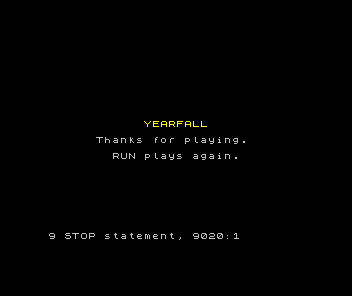
Having one exit also gives you one place to change it. A closing sound, or a final summary, would go in this routine once rather than being copied to five lines.
After quitting, you type RUN. Why does the game start at its title, not at the year you left?
Show the explanation
RUN clears all the variables and starts from the first line, so line 10 draws the title again. Quitting kept nothing for the program to return to. Restarting a saved year would need a different, deliberately designed entry point.
Check it, then save it again
- Make several edits in a row, including a cancel with X and a blank Enter. Only figures and messages should change.
- Enter 9999 for food. The message should say the grain is short, and the forecast row below it should go blank.
- Commit a harvest and continue. The next year’s plan should show the new year and resources.
- Quit from the title, the plan, a harvest report, a ten-year review and a traveller offer. Each should end on the closing screen with the report naming line 9020.
The emulator checks for this lesson play through those cases, watch the title row’s screen memory for writes during edits, and run the earlier full checks, including a thirty-year seeded game. The same checks run against the previous program fail on the redraws and on every quit, so they test what this lesson changes.
Your saved tape from the previous lesson still holds the older program. Save this version with SAVE "yearfall" LINE 10 and check it in a fresh session, as in Keep the settlement.
Sources
Steven Vickers, edited by Robin Bradbeer, ZX Spectrum BASIC Programming, second edition (Sinclair Research, 1983), chapter 8 (string slicing, including empty slices), chapter 15 (PRINT AT and CLS), appendix B (reports and their line and statement numbers).
Run it here
This unit's program, built for you.
- Program
- yearfall.tap
- Machine
- ZX Spectrum 48K (PAL)