
Every storm’s finish bonus has been the same deal: ten points for each second under 100. A fast fifth storm paid no more than a fast first one, although the player had to survive four storms to reach it. In this lesson each storm’s bonus is multiplied by the storm’s number: ×1 for the first, up to ×5 for the fifth.
The Z80 has no multiply instruction. Here we multiply the way it is usually done for small numbers: by adding the same thing several times.
Source · view and edit
Companion file: assets.inc
The include line reads this editable data when you assemble. Keep it beside your source for a local build.
Edit the source, then assemble.
Edits are saved in this browser. Keep a downloaded copy of work you want to keep.
Focus the Spectrum screen to use the keyboard, or hold these buttons. Assemble again for a fresh machine.
Run the program to inspect it. Editing source does not change the running machine.
phase- —
storm- —
finish_points- —
score- —
elapsed- —
Space launches; O/P steer; hold Space for 2X. One hit ends the voyage. At the result R retries from the first storm and Q returns to the title.
Cross a storm and read the interlude: the bonus line now says what it is multiplied by.
What you should see
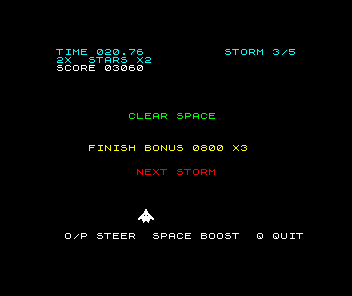
The interludes read FINISH BONUS 0800 X1, then X2 and so on, and the score jumps further each time. The title’s bonus line now reads FAST FINISH: BONUS X STORM.
Multiplying by adding
Here is where storm_cleared adds the bonus:
finish_bonus:
 ld (finish_points),a
 ; Storm n's bonus counts n times: add it once for each storm so far.
 ld e,a
 ld d,0
 ld a,(storm)
 inc a
 ld b,a
 ld hl,(score)
bonus_add:
 add hl,de
 djnz bonus_add
 ld (score),hl
 ld hl,(elapsed)
The bonus goes into DE as before. Then storm, which counts from 0, plus 1 goes into B: 1 for the first storm, 5 for the fifth. The loop at bonus_add adds DE to HL, and djnz counts B down and jumps back until it reaches zero. So the bonus is added B times: the bonus times the storm’s number.
That is how unit 14 found an event’s address, with five add hl,de instructions in a row, and how unit 29 found a course with two. There the multiplier was fixed and the additions were written out. Here it changes with the storm, so a loop does the counting.
Repeated addition is only sensible because the multiplier is small. The largest bonus is 99 tens, for a storm under a second, and five additions of it make 495 tens: unit 30’s two-byte score has room to spare.
Why `inc a` before `ld b,a`? What would the loop do for the first storm without it?
Show the explanation
storm is 0 for the first storm, so without inc a, B would be 0. djnz takes 1 from B before it tests B, and 0 minus 1 is 255, not zero. The loop would run 256 times: a bonus of 80 would add 20,480 tens. The score line can only print four digits of tens, so its first digit would run past 9 into other characters.
Naming the multiplier
A bonus that changes from storm to storm needs explaining on screen. bonus_line writes the storm’s digit into the line before it prints it:
bonus_line:
 ld a,(storm)
 add a,'1'
 ld (bonus_storm),a
 ld a,(finish_points)
 ld hl,bonus_digits
 call decimal3
 ld bc,$0C05
 ld de,bonus_text
 jp text
storm plus the character code of '1' gives '1' to '5', the trick hud uses for STORM 3/5. The text it lands in is three pieces with labels, so the program can write into the middle of it:
bonus_digits: defb "0000"
bonus_times: defb " X"
bonus_storm: defb "1",0bonus_text, the digits and bonus_times have no zero byte between them, so text prints straight through all three and stops at the zero after bonus_storm.
One more change keeps the line honest. start_storm now sets finish_points to 0 when a storm begins. Before this, a ship lost in the third storm showed the second storm’s bonus on the result screen with the third storm’s number beside it. Now it shows FINISH BONUS 0000 X3: nothing earned in the storm it was lost in.
How much more
On the route the checks fly, with Space held, the storms and their bonuses come out like this:
| Storm | Time | Bonus | × | Added |
|---|---|---|---|---|
| 1 | 20.92 s | 80 | 1 | 80 |
| 2 | 20.92 s | 80 | 2 | 160 |
| 3 | 20.80 s | 80 | 3 | 240 |
| 4 | 21.60 s | 79 | 4 | 316 |
| 5 | 19.60 s | 81 | 5 | 405 |
The route and the stars are the same as in unit 30, so the only difference is the multiplied bonuses: 801 tens more than before. The voyage that ended at 05140 now ends at 13150.
With the bonus multiplied, which storm is it most worth speeding up for, and by how much?
Show the explanation
The fifth. Each second saved adds one to the bonus, and the bonus counts five times there, so a second faster in the fifth storm is worth 50 points. In the first storm it is worth 10.
Experiments
Keep a working copy before each change, then press Revert when you have finished.
Replace `inc a` with `add a,a` and cross the second storm. What does the interlude say, and how much is added?
Show the explanation
storm is 1 in the second storm, and doubling it gives 2: the same as inc a would. The line says X2 and adds 160, so nothing seems wrong. The third storm gives 4 instead of 3 and the fifth 8 instead of 5, while the line still says X3 and X5. And the first storm gives B=0 and 256 additions. A change that works for one test case is not enough: try the first and the last as well.
Then make the bonus count for the storms still to come instead: ld a,STORMS and sub the storm number, so the first storm counts five times and the last once. Which voyage does that reward?
The score now rewards getting further. The storms themselves are still alike: the same speeds, the same density, the same colours. The next lesson makes each storm harder than the last.
Sources
Zilog, Z80 CPU User Manual, UM008011-0816: DJNZ decrements B and jumps unless the result is zero; ADD HL,ss. The maintained Meteor Storm source linked through this page supplies the bonus code, and its verification flies the measured route and reads every interlude’s bonus line back from the screen. The screenshot is a native Emu198x capture of this program.
Run it here
This unit's program, built for you.
- Program
- meteor-storm.tap
- Machine
- ZX Spectrum 48K (PAL)