
Meteor Storm’s title screen sits still until someone presses Space. Arcade machines of the period never did: between games they played themselves, to catch the eye of anyone walking past. That was called attract mode, and many home computer games copied it.
In this lesson the title plays the first storm behind its text, without a ship, and the prompt flashes. Almost everything it needs already exists: the object pool, the course, the routines that move and draw. The new work is in running them where nothing can be hit, and in making text flash without drawing it again.
Source · view and edit
Companion file: assets.inc
The include line reads this editable data when you assemble. Keep it beside your source for a local build.
Edit the source, then assemble.
Edits are saved in this browser. Keep a downloaded copy of work you want to keep.
Focus the Spectrum screen to use the keyboard, or hold these buttons. Assemble again for a fresh machine.
Run the program to inspect it. Editing source does not change the running machine.
phase- —
active_count- —
wave- —
ticks- —
Run the program and leave it on the title. Space launches as before; O/P steer; hold Space for 2X.
What you should see
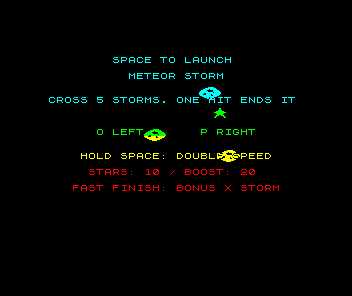
SPACE TO LAUNCH has moved to the top of the screen, above the name, and flashes. Meteors and stars fall through the title in its colour bands, crossing the lines of text and leaving them as they were. After about 36 seconds the course runs out and starts again. If you have a voyage record, it shows lower down, at row 20.
A storm with nobody in it
The title already cleared the screen and printed its text. Now, after printing, it also sets up a storm:
title_no_record:
 ; The attract storm: an empty run block and the first storm's course.
 xor a
 ld hl,state_start
 ld de,state_start+1
 ld bc,state_end-state_start-1
 ld (hl),a
 ldir
 call start_storm
 call release_keys
title_title_wait:
 halt
 ld a,(frames)
 and 1
 call z,attract_step
 ld bc,$7FFE
 in a,(c)
 bit 0,a
 jr nz,title_title_wait
 call release_keys
 call new_game
The six instructions after the comment are new_game’s: they fill the run’s block of memory with zeros, which empties the object pool and sets storm to 0. start_storm then points course at the first storm’s table, sets its rules and starts the course from the top.
The wait for Space gains three lines. After each halt, on even frames, it calls attract_step:
; One update of the storm behind the title, in the main loop's order: move,
; spawn, count, step. There is no ship: phase 0 skips contact. When the
; course is over and the playfield empty, it starts again.
attract_step:
 xor a
 ld (boost_time),a
 inc a
 ld (steps_left),a
 call advance_meteors
 call waves
 call count_objects
 ld hl,(ticks)
 inc hl
 ld (ticks),hl
 ld a,(wave)
 cp WAVES
 ret nz
 ld a,(active_count)
 or a
 ret nz
 jp start_storm
This is the main loop’s update, in the same order: move every object, perhaps spawn the next, count what is left, and add one to the course step. There is no boost, so boost_time is 0, and one step per update, so steps_left is 1. When every event has been read and the playfield is empty, jp start_storm starts the course again: start_storm ends with ret, which returns to the title’s loop as attract_step would have.
Every second frame, as in flight, because the title runs at the speed of the game. A storm behind the title that moved twice as fast as the real one would teach the eye the wrong speed.
Nothing to hit
advance_meteors was written for flight. Near the bottom of the screen it tests each object against the ship, and a meteor there clears hull. On the title there is no ship, but ship_x still holds a value, so a meteor falling past X 116 would count as a hit. The contact test now starts by asking which phase the game is in:
 ; The title's attract storm has no ship to hit.
 ld c,a
 ld a,(phase)
 or a
 jp z,advance_meteors_skip
 ld a,c
The object’s Y is still in A, so it is parked in C while A reads phase. On the title phase is 0, and the jump skips the contact test entirely: meteors fall past, and stars are not collected. In flight phase is 1, and the test runs as before.
Why does the program put `phase` to work here, rather than giving attract mode its own copy of advance_meteors?
Show the explanation
A copy would be a second routine of nearly a hundred lines to keep in step with the first. Every later change to how objects move or draw would have to be made twice, and the title’s storm would drift away from the real one. One test, in the one place the behaviour differs, keeps the two the same.
Drawing through text
The title’s text is drawn once, with ordinary stores. The meteors are drawn over it with draw_sprite, which has used XOR since unit 4. Where a meteor’s pixels land on a letter’s, the two combine, so the letters show through as holes in the meteor. When the meteor is erased, XOR-ing the same pixels again takes them out and leaves exactly the letters that were there.
That only works if nothing else writes those pixels in between, the condition unit 5 set out when it first erased the ship. If the title printed text over a meteor with an ordinary store, the store would wipe the meteor’s pixels from those bytes. When the meteor was erased, XOR would then cut its shape out of the letters. So the title text is drawn before the storm starts and never again while it runs.
The checks hold the program to this. They record the screen before the first meteor appears, let the course run all the way through (1,790 frames) and compare: every byte of the bitmap is as it was drawn.
A flashing prompt
The prompt has to flash, but redrawing it would break that rule. The Spectrum can flash text without touching its pixels at all. Bit 7 of an attribute byte, which unit 28 decoded, is FLASH: in a cell with FLASH set, the ULA swaps INK and PAPER over every 16 frames, so the text turns from cyan on black to black on cyan and back.
 ; The prompt sits in row 1, above the attract storm, and flashes: bit 7
 ; of each of its row's attribute bytes is FLASH.
 ld b,$01
 ld de,title_start
 call text_center
 ld hl,$5800+32
 ld b,32
title_flash:
 set 7,(hl)
 inc hl
 djnz title_flash
set 7,(hl) sets bit 7 of the byte HL points at and leaves the other bits alone, so each cell keeps its colours and gains FLASH. The loop walks the 32 attribute bytes of row 1, from $5800+32.
Why row 1? A flashing cell flashes whatever is in it. If the prompt stayed in row 20, every meteor falling through row 20 would flash too. The course starts at Y 24, row 3, so rows 0 to 2 are never crossed, and the prompt moves up there. The record takes row 20 in its place.
When Space starts a run, new_game’s clear repaints every row from the colour table, and FLASH is gone.
Change `ld hl,$5800+32` to `ld hl,$5800+320`, row 10, which holds O LEFT and P RIGHT. What happens on the title?
Show the explanation
Row 10 flashes instead: O LEFT and P RIGHT swap colours every 16 frames, and so does every meteor and star while it falls through row 10. The colour belongs to the cells, and the meteor is only passing through them. SPACE TO LAUNCH, in row 1, stays still.
Experiments
Keep a working copy before each change, then press Revert when you have finished.
Delete the five lines from `ld c,a` to `ld a,c` in advance_meteors, then watch the title. What happens, and does it matter?
Show the explanation
Meteors falling near X 116 at the bottom now count as hits: hull goes to 0, and stars near X 116 add to score. Nothing on the title reads either, so the screen looks the same, and new_game resets both when a run starts. It matters for anything that would read them later. A routine that quietly changes state no one asked it to change is a bug that waits for its moment.
Then try running the attract storm at the fifth storm’s rules: give the title’s start_storm a storm of 4 by storing it after the block is cleared. Which looks better behind the title?
The title now shows the game off. There is one wait left with nothing to look at: the two minutes the tape takes to load. The next lesson fills it with a picture.
Sources
Sinclair Research, ZX Spectrum BASIC Programming, chapter 16, colours: FLASH as 128 in an attribute value, alternating INK and PAPER. Zilog, Z80 CPU User Manual, UM008011-0816: SET b,(HL) sets one bit of the byte HL points at. The maintained Meteor Storm source linked through this page supplies the title and attract_step; its verification checks the flashing row, that objects fall with nothing to hit, that a whole attract course leaves the title bitmap exactly as drawn, and that a launch starts on an empty playfield. The screenshot is a native Emu198x capture of this program.
Run it here
This unit's program, built for you.
- Program
- meteor-storm.tap
- Machine
- ZX Spectrum 48K (PAL)